
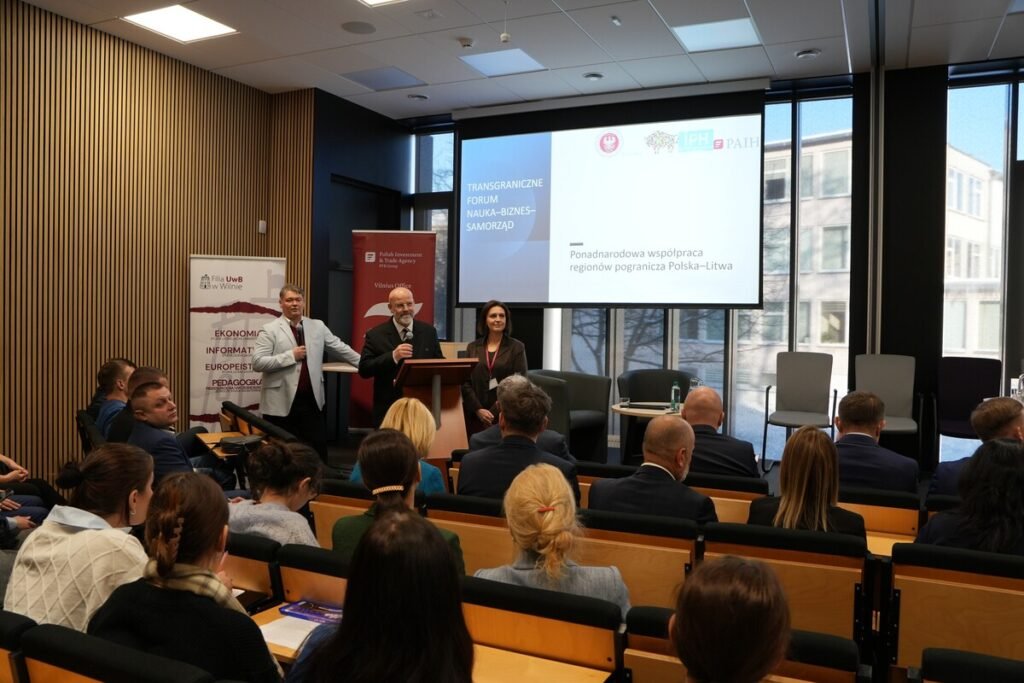
The First 2026 Cross‑Border Business and Local Government Forum in Vilnius
On 16 January 2026, the branch of the University of Białystok in Vilnius hosted the Cross‑Border Science, Business and Local Government Forum, an event that once again showed that the border regions of Poland and Lithuania share not only a common history, but also a common vision for the future. The forum brought together representatives of academia, business and local government who were looking for practical ways to turn knowledge into real projects, new partnerships and tangible regional development on both sides of the border.
High‑level participants
The forum in Vilnius attracted an impressive group of guests from Poland and Lithuania. Among the participants were the Rector of the University of Białystok, Professor Mariusz Popławski, Vice‑Rector Dr hab. Tomasz Bajkowski, Dean of the Vilnius branch Dr hab. Urszula Wróblewska, Marshal of the Podlaskie Voivodeship Łukasz Prokorym, Honorary Consul of Lithuania in Poland Tomasz Kurciński, Head of the Polish Investment and Trade Agency (PAIH) office in Vilnius Mark Zinkevič, President of the Chamber of Industry and Commerce in Białystok Jarosław Antychowicz, Chancellor of the University of Białystok Tomasz Zalewski and other institutional partners. This line‑up clearly shows that the forum is seen not only as an academic event, but also as a genuine platform for political, economic and social dialogue for the border regions.
Four panels, from development strategies to innovation
The programme of the event consisted of four thematic discussion panels focused on the key challenges that border regions face today. The panels addressed regional development strategies, opportunities for cross‑border business cooperation, the commercialisation of research results and the use of European Union and regional funds to support innovation and social initiatives. Importantly, the discussions did not stop at general declarations, participants focused on specific models of cooperation, project ideas and practical mechanisms that could help transfer academic results more quickly into business practice and local decision‑making.
Academia, business and local government as one chain
During the forum, speakers repeatedly stressed that sustainable development of border regions is impossible without ongoing dialogue between universities, entrepreneurs and local authorities. Universities act as centres of expertise and can offer solutions based on research, business is the natural environment for implementing innovation, while local government provides the framework and conditions without which long‑term initiatives often remain only on paper. A meeting such as this forum creates a space where new contacts are made and existing relationships between institutions are maintained and strengthened, and where participants gain a better understanding of each other’s logic, expectations and constraints, from which concrete joint projects can grow.
New projects and partnerships, here and now
The forum in Vilnius is an important sign that cross‑border cooperation is not just an attractive phrase in strategy documents. Direct meetings, face‑to‑face conversations and shared discussions in one place create the conditions for new initiatives in areas such as science, education, business, culture and social integration. Events of this kind become a sort of incubator for ideas, for research projects, for student and staff exchanges, for initiatives that support entrepreneurship and for infrastructure development that matters to the entire border region, not only to a single municipality.
Too little information, a missed opportunity for wider engagement
From the point of view of public communication, one weakness can also be seen, information about the planned forum before it took place was rather limited. This is a pity, because an event of this level could have attracted a wider circle of academics, students, NGOs and local businesses if communication around it had been more visible and consistent both in Lithuania and in Poland. Better communication would not only have strengthened the visibility of the forum, it would also have increased the number of potential partners and participants, which in practice means more ideas, more relationships and more possible projects in the future.
Why forums like this matter
Despite these communication shortcomings, the forum itself and its content should be assessed very positively. It is very good that events of this kind are taking place, as they create a space where different experiences, interests and competences meet, and where new projects, initiatives and partnerships can emerge, with real potential to change the face of border regions. The more often such formats of dialogue are organised, the stronger the trust between institutions and business will be, and the easier it will become to tackle shared challenges such as youth emigration, a lack of quality jobs, the need to implement innovation or the reduction of social exclusion.
The border regions of Poland and Lithuania have potential
The Cross‑Border Science, Business and Local Government Forum in Vilnius showed that the Polish and Lithuanian border regions have the potential to act as one closely connected organism, based on shared ideas and a shared responsibility for the future. One can only hope that in the coming years similar initiatives will receive more public attention, and that their outcomes will be visible not only in conference halls, but also in the everyday lives of people living on both sides of the border.
Lietuvosvalstybe.com