
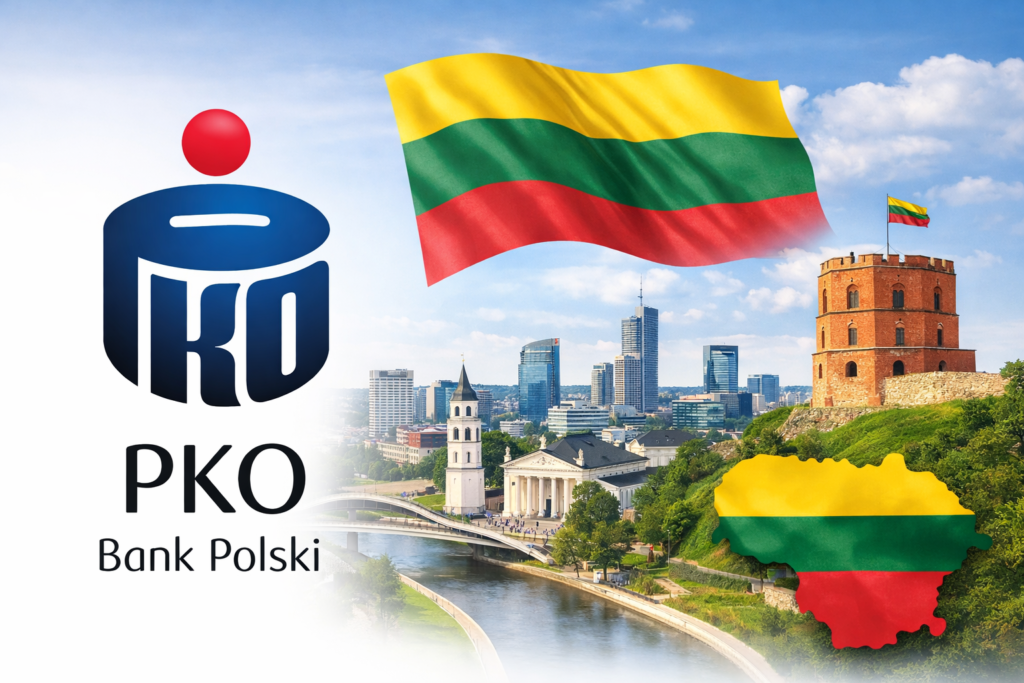
Poland’s Largest Bank Expands into the Baltic Region
Poland’s largest bank, PKO Bank Polski, officially established its representative office in Lithuania’s capital, Vilnius, on December 19, 2025. This step is regarded as a strategic direction in the bank’s expansion, aimed at fostering cross-border transactions, analysing the Lithuanian market and strengthening the PKO Bank Polski brand across the Baltic and Northern European region.
At this stage, PKO Bank Polski’s representative office in Lithuania will not provide traditional banking services. Its activities will focus on marketing, monitoring local market developments and identifying business opportunities. Could this move become the first step toward establishing a fully operational bank branch in Lithuania? The bank does not rule out such a possibility in the long term.
Why Lithuania?
Representatives of PKO Bank Polski emphasise that Lithuania is an attractive destination for several reasons. The country hosts a significant number of companies with Polish capital and is actively investing in green energy, infrastructure and regional development projects.
Can the arrival of a major Polish bank — even in the form of a representative office — strengthen competition in Lithuania’s relatively concentrated banking sector? Could it lead to better conditions for businesses, especially international companies operating in Lithuania? It is still too early to draw firm conclusions, but a positive impact appears likely. Much will depend on the broader economic and political environment, the bank’s strategic decisions and the leadership of its Lithuanian representative office.
The Broader PKO Context
PKO Bank Polski already operates in Germany, the Czech Republic, Slovakia and Romania, and is also present in Ukraine through Kredobank. In addition, the bank plays a major role in correspondent banking, handling settlements with more than 1,300 financial institutions in 23 currencies. This accounts for approximately half of Poland’s interbank market.
This extensive international network enables the bank to offer solutions tailored to cross-border business needs. The key question remains whether similar expertise and a comparable range of services will eventually be introduced in Lithuania.
Opinion: New Opportunities for Lithuanian and Polish Businesses
Leonard Jakubenas, Head of the Baltic and Polish Business Association, views PKO Bank Polski’s entry into Lithuania as a positive signal for businesses across the region. In his view, PKO Bank Polski is a strong institution — the largest bank in Poland — and the establishment of a representative office in Lithuania demonstrates serious long-term intentions.
According to Leonard Jakubenas, the bank’s presence in Lithuania is a welcome development for both Lithuanian and Polish companies, particularly those already engaged in or planning cross-border operations. Even in a representative format, the bank’s arrival could contribute to a more competitive banking environment and open up additional opportunities for businesses.
Leonard Jakubenas also draws on his personal and professional experience. He is a client of PKO Bank Polski in Poland, both as a private individual and as a representative of Lithuanian and Polish companies. As a lawyer specialising in international business relations, he has assisted numerous Lithuanian and Polish companies with Lithuanian capital in opening accounts specifically with this bank. According to him, clients are satisfied with the quality of services, business solutions and the bank’s overall cooperation culture.
Can this positive experience from the Polish market be replicated in Lithuania? Leonard Jakubenas believes there is clear potential, but stresses that final outcomes will only become evident over time. Much will depend on the bank’s strategy, its decisions and the depth of its actual engagement in the Lithuanian market.
Conclusion
Growing interest from foreign banks signals the maturity of Lithuania’s financial market and the increasing attractiveness of the Baltic region as a whole. Even the establishment of a representative office can become an important step toward enhancing competition, expanding the range of financial services and strengthening Lithuania’s position as a regional business hub.
Whether PKO Bank Polski’s presence will remain largely symbolic or mark the beginning of deeper integration into Lithuania’s financial sector remains an open question. What is already clear, however, is that this move is stimulating discussion about the future of the banking market and creating new expectations for Lithuanian and Polish businesses alike.
Lietuvosvalstybe.com
When quoting or distributing content from lietuvosvalstybe.com, a reference to the source is required.